
 To continue a particularly popular trend in the field of AI, this time we compare two AIs, Google's and Brave's. This article is based on the same questions for both AIs, through which we will try to grasp their different approaches, both logical and content-related. Remember that each AI, at this stage, is first and foremost a true information eater. Therefore, the depth, depth, and quality of the responses is essentially based on the quantity of data that the AI has managed to store and then process on a specific topic. You will therefore notice a certain, obvious, "discrepancy" between the two AIs for the same question; sometimes even a certain contradiction seems to emerge. If that were not the case,
this would mean that the two AIs draw directly from the same database... which could happen in the not-too-distant future, but not yet. Therefore, you can understand WHICH of the two AIs is more preferred by users in dealing with these topics, and... if you pay a little attention, you can also see which of the two AIs has a "less diverse" audience than the other. The choice of the theme, that of Mary of Nazareth, was made precisely to allow the AI to explore the time and culture of multiple peoples and thus have "wide-ranging" comparisons, so to speak, and then attempt to focus and shorten the reasoning with provocative questions. The conclusion, as always, delves into an introspective look at the system with an analysis that could outline a possible future. Happy reading.
WHAT CAN YOU TELL ME ABOUT THE MADONNA?
[Google AI] - The term "Madonna" primarily refers to Mary of Nazareth, the mother of Jesus, a central figure in Christianity and Islam. If your question concerns the famous American pop singer or the renowned ski resort in Trentino, the answer is completely different. Below, you'll find the key details, divided into the three most common meanings of the word.
The Blessed Virgin Mary (Religion and Art)
In religion and art, "Madonna" derives from the ancient Italian "Mia Donna" (Lady) and is the title par excellence of the Mother of God.
Theological Role: For Catholics and Orthodox, she is the human figure closest to God, conceived without original sin (Immaculate Conception) and assumed into heaven body and soul.
The Four Catholic Dogmas: Divine Motherhood, Perpetual Virginity, Immaculate Conception, and Assumption.
In Art: It is the most depicted subject in the history of Western art. Among her most famous masterpieces are Michelangelo's Pietà, Raphael's Sistine Madonna, and Caravaggio's Madonna of the Pilgrims.
Madonna (The Queen of Pop)
If you're referring to pop culture, Madonna Louise Veronica Ciccone (born 1958) is one of the greatest icons of world music.
Record: She is the female artist with the most album sales in the history of music (over 300 million).
Cultural Impact: Famous for revolutionizing pop in the 1980s and 1990s with global hits like "Like a Virgin," "Like a Prayer," and "Vogue," combining music, religious provocation, fashion, and civil rights.
Madonna di Campiglio (Geography)
In terms of geography and tourism, it is one of the most famous ski resorts in Italy.
Location: It is located in Trentino-Alto Adige, nestled between the Brenta Dolomites and the Adamello.
Importance: It is an elite winter sports destination, famous for hosting historic Alpine Skiing World Cup races (on the 3-Tre slope) and for its summer nature tourism.
Which of these three figures or locations were you most interested in? I can delve deeper into the history of religious dogma, the singer's recording successes, or the hiking trails of Campiglio.
[IA di Brave] - Madonna is the Italian term for the Virgin Mary, mother of Jesus, and derives from the Latin mea domina (my lady). Historically, it was a courtesy title addressed to women of high social rank or to the beloved woman in troubadour and Petrarchan poetry, but today it refers to the Christian sacred figure par excellence. In culture and everyday language, the term has various meanings:
Religious: It indicates the mother of Jesus, venerated with specific titles such as Immaculate, of the Rosary, of the Seven Sorrows, or Salus Populi Romani.
Artistic: It refers to figurative representations of the Virgin, famous works by artists such as Raphael (e.g., the Madonna della Seggiola).
Colloquial: It is used in exclamations of amazement or pain (My Madonna!) or in idiomatic expressions such as "pull down the Madonnas" (to blaspheme) and "have the face of a Madonna" (to indicate a sweet and composed beauty).
TELL ME ABOUT MARY OF NAZARETH AND HER ICONOGRAPHY OVER TIME.
[Google AI] - The iconography of Mary of Nazareth has undergone a radical evolution over the centuries. She went from being a shy, clandestine symbol in the catacombs to becoming the majestic imperial sovereign of the Byzantine era, and finally embodying the profoundly human and psychological mother of the Renaissance. The historical evolution and traditional figurative models that have defined the image of the Madonna over time follow precise chronological and stylistic stages.
Chronological Evolution of Iconography
1. Origins and the Catacombs (2nd - 4th Century)
The oldest Marian image in the world is found in the Catacombs of Priscilla in Rome (circa 230 AD). Mary is depicted seated, breastfeeding the Child, flanked by a prophet (perhaps Balaam) pointing to a star. The style is classical Roman, simple, devoid of ostentation, and tied to the intimate dimension of motherhood.
2. The Byzantine Era and the Icon (5th - 11th century)
The real turning point came with the Council of Ephesus (431 AD), which solemnly proclaimed Mary as Theotokos (Mother of God). From this moment, art abandoned Roman realism:
Images became fixed, two-dimensional, and hieratic.
Mary wears the maforion (a long purple or dark blue veil that covers her head and shoulders) adorned with three stars, symbols of her virginity before, during, and after childbirth.
The gold backgrounds symbolize the divine light of eternity.
3. The Late Middle Ages and Humanization (12th - 14th century)
With the advent of artists such as Giotto and Cimabue, art opened up to three-dimensionality and human sentiment. Alongside the traditional Majesty (the Madonna enthroned), the model of the Madonna of Humility emerged: Mary no longer sits on an imperial throne, but directly on the ground or on a cushion, accentuating her connection with the faithful and her earthly simplicity.
4. The Renaissance and Psychological Realism (15th - 16th centuries)
In the Renaissance, Mary sheds her divine rigidity to become a real woman, beautiful and psychologically complex.
Leonardo da Vinci experiments with the delicacy of maternal affection.
Raphael paints Madonnas with a serene, ideal yet profoundly human beauty.
In his celebrated Annunciation, Antonello da Messina eliminates the angel from the scene, focusing the entire painting on the intimate, psychological, and modern gaze of Mary, taken by surprise.
Michelangelo sculpts the Pietà, introducing an innovative contrast: a very young Mother, whose face is not distorted by pain but frozen in composed, eternal acceptance.
5. From the Baroque to the Modern Age (17th - Present)
During the Counter-Reformation, Caravaggio disrupts tradition by using common women (even models known as courtesans) to portray the Virgin, showing her barefoot and in humble settings (Madonna dei Pellegrini). In the following centuries, iconography settled on dogmatic and ethereal visions, such as the Immaculate Conception (wrapped in white and blue robes, crushing the serpent), until arriving at the geometric or abstract reinterpretations of the 20th and 21st centuries.
The Great Traditional Iconographic Models
Eastern and Western Christian traditions have categorized the figure of Mary into fixed compositional typologies:
Hodegetria (She who shows the way): The Virgin holds the Child Jesus in one arm and points to Him with the other, showing the faithful the "Way" of salvation.
Platytera (Wider than the Heavens) / Blachernitissa: Mary is depicted frontally with open arms in a prayerful attitude, with a medallion on her chest containing the infant Christ, symbolizing the womb that contained the Uncontainable.
Galaktotrophousa (Madonna of the Milk): Mary captured in the intimate and human act of breastfeeding the Child, a very popular model to emphasize the true incarnation of Christ.
Eleusa (Madonna of Tenderness): The Child places his cheek against that of his Mother, who gazes at him with melancholy eyes, foreshadowing the future sacrifice of the Passion.
Madonna of Mercy: Mary stands and opens her large protective cloak to welcome and protect the entire community of the faithful or specific confraternities beneath it.
[IA di Brave] - Mary of Nazareth: Historical and Biblical Figure
Mary of Nazareth was a young Jewish woman, likely between the ages of 12 and 16 at the time of her betrothal to Joseph, who lived in the small Galilean town of Nazareth. Born into a humble but devout family, her biography is intertwined with key events of the Christian faith: the Annunciation by the angel Gabriel, the Visitation to her cousin Elizabeth, the Nativity in Bethlehem, the Flight into Egypt, and the hidden life in Nazareth. Scripture portrays her as a central figure in her Son's mission: present at the Wedding at Cana, where she receives the first miracle, and beneath the Cross, where she receives the spiritual motherhood of all believers. After the Ascension, the Acts of the Apostles recall her praying with the nascent community awaiting the Holy Spirit. Tradition, supported by apocryphal texts such as the Protoevangelium of James, adds details about her childhood and her "Dormition" or Assumption.
Evolution of Marian Iconography
The iconography of Mary is the richest and most varied theme in Christian art, evolving alongside theological development and cultural changes.
From the Origins to the Middle Ages: The Theotokos
The earliest representations (3rd century, Catacombs of Priscilla) show Mary seated with the Child, an image that became consolidated after the Council of Ephesus (431). This council, condemning Nestorianism, proclaimed Mary Theotokos ("Mother of God"), legitimizing her majestic depiction.
Byzantine Art: Hieratic frontality prevails. Famous types include the Hodegetria ("She who shows the way," with Jesus blessing in her arms) and the Nikopoia ("Bringer of Victory," with the Child on her lap like a throne).
Western Middle Ages: Majesty spreads, where Mary is seated on a royal throne, often austere and distant, a symbol of the triumphant Church.
The Renaissance: Humanization and Gentleness
With Humanism, iconography undergoes a revolution: Mary loses her Byzantine rigidity to acquire a profound humanity.
Intimacy: Artists such as Raphael and Leonardo da Vinci paint intertwined glances, affectionate embraces, and domestic scenes. The Madonna of Humility (seated on the ground) and the Madonna of the Book are born.
The Madonna of the Milk (Galaktotrophousa): Widespread since the 12th century but flourishing between the 14th and 15th centuries, it represents breastfeeding as a symbol of the Incarnation and the transmission of divine wisdom, overcoming taboos on partial nudity to emphasize real motherhood.
Modern and Contemporary Ages: Dogma and Devotion
From the 16th century onward, art responded to the demands of the Counter-Reformation and new dogmas.
Immaculate Conception: Promoted by the Jesuits in the 17th century, it depicts Mary as a young woman bathed in light, often with the moon under her feet and a crown of stars, deprived of the Child.
Mater Dolorosa: Depicted with her heart pierced by seven swords or in the Pietà with the dead Christ, it emphasizes maternal compassion and grief.
Our Lady of Mercy: A protective figure who welcomes the faithful under her ample cloak.
Today, contemporary art tends to depict Mary no longer as a distant queen, but as a "handmaid of the Lord," close to everyday human experience, while maintaining traditional symbols such as the blue cloak (heaven/divinity) and the red robe (humanity/passion).
WHAT IS KNOWN ABOUT HER LIFE?
[Google AI] - The historical life of Mary of Nazareth is reconstructed by combining the scant data from the canonical Gospels, historical details about first-century Galilee, and the devotional narratives of the Apocryphal Gospels (which have influenced art, despite not being official religious texts). Biographical information about Mary is divided between essential historical data, episodes reported in the sacred texts, and later traditions.
Historical Profile and Actual Context
Modern historical research presents a woman perfectly integrated into the Jewish world of Palestine under the Roman Empire.
Origin and Name: Her original name was Miryam (in Aramaic). She was presumably born in the final years of the reign of Herod the Great (late first century BC).
Social Status: She lived in Nazareth, a tiny, poor rural village in Galilee with a few hundred inhabitants. She spoke Aramaic and was probably illiterate, like almost all village women at the time. Marriage: According to the Jewish laws of the time (the Halakha), Miriam was betrothed to Joseph at a very young age, around 12-14, when girls entered childbearing age and marriage contracts were drawn up between families.
Life in the Canonical Gospels (Theological Biography)
The four Gospels of Matthew, Mark, Luke, and John do not offer a complete chronological biography, but mention Mary only at key moments in Jesus' life:
The Annunciation and Childhood: The evangelist Luke recounts that the angel Gabriel announced the birth of Jesus to her. After traveling to Bethlehem for the Roman census and the birth of her son, the family briefly fled to Egypt to escape Herod's persecution.
Jesus' public life: Mary reappears at the Wedding at Cana, where she inspires her son to perform his first miracle (turning water into wine). The Gospels also mention moments of tension, when the family expressed concern about Jesus' radical preaching.
The Crucifixion: Mary is present on Calvary at the foot of the cross. Jesus, before dying, formally entrusts her to the apostle John, saying: "Woman, behold, your son."
The first Christian community: The last mention of Mary in the New Testament is found in the Acts of the Apostles, where she is described praying in Jerusalem with the apostles on the day of Pentecost.
Apocryphal Traditions (Details of the legend)
Because the official biblical texts left many gaps, the faithful of the early centuries wrote the Apocryphal Gospels (such as the 2nd-century Protoevangelium of James). Although the Church does not consider them inspired by God, they are the source of almost all the stories we know about her life and that artists have depicted for centuries:
Parents and Birth: The Apocrypha reveal the names of Mary's parents, Saints Joachim and Anne, described as an elderly, sterile couple who received the miracle of a daughter.
Childhood in the Temple: It is said that at the age of three, Mary was consecrated to the Temple in Jerusalem, where she grew up sewing the temple veil and leading a most pure life.
The Choice of Joseph: When Mary became a teenager, the priests sought a guardian. Joseph was chosen because his staff miraculously blossomed and a dove landed on his head.
The Dormition and Death: The exact place of her death is unknown (traditions are divided between Jerusalem and Ephesus, in present-day Turkey). Apocrypha describe her "Dormition" (Transitus Mariae): Mary did not die of illness, but rather fell asleep and was then assumed into heaven by angels.
[Brave IA] - Information on the life of Mary of Nazareth comes primarily from the canonical Gospels (especially Luke and Matthew), supplemented by oral traditions and apocryphal texts (such as the Protoevangelium of James), which fill in the "silences" in the Scriptures regarding her childhood and the end of her life.
Biblical Sources: Reliable Historical Data
The Gospels offer a basic biographical outline, focusing on Mary's role in salvation history rather than personal details.
Origin and Annunciation: Mary lived in Nazareth, a humble village in Galilee. She was betrothed to Joseph, of the house of David. Around 6-5 BC, she received the annunciation from the angel Gabriel (Luke 1:26-38), agreeing to become the mother of Jesus through the power of the Holy Spirit.
Motherhood and Escape: After visiting her cousin Elizabeth (Visitation), she gave birth to Jesus in Bethlehem during a census. The family was forced to flee to Egypt to escape the massacre ordered by Herod the Great, returning to Nazareth only after the king's death.
Hidden and Public Life: The Gospels are almost entirely silent about her later years. She is found at the Temple in Jerusalem when Jesus is 12 years old and, later, at the Wedding at Cana, where she intercedes for the first miracle.
Passion and the Early Church: Mary is present beneath the Cross (John 19:25), where Jesus entrusts the disciple John (and symbolically all believers) to her. After the Ascension, the Acts of the Apostles describe her praying in the Upper Room with the apostles awaiting Pentecost (Acts 1:14). From this point, the Scriptures report nothing else.
Traditions and Apocrypha: Childhood and "Dormition"
To reconstruct her complete biography, Christian tradition has relied on 2nd-century texts such as the Protoevangelium of James and the Transitus.
Childhood: According to these texts, Mary was born to elderly and sterile parents, Joachim and Anne. She was offered to the Temple in Jerusalem at a young age to be educated and married to Joseph (often described as an elderly widower) to preserve her virginity.
Last Years and Death: There is no biblical account of her death. Tradition (supported by texts such as the Transitus of the Virgin) holds that Mary spent her last years in Jerusalem or followed the apostle John to Ephesus.
Dormition and Assumption: Mary is believed to have died ("fell asleep") between 41 and 48 AD, at approximately 50–70 years of age. Her body was placed in a tomb in Gethsemane. Tradition holds that her body was assumed into heaven shortly thereafter, a dogma officially proclaimed only in 1950 by Pope Pius XII, but believed since the earliest centuries.
WHO DO YOU THINK OUR LADY... MARY OF NAZARETH IS?
[Google AI] - As an artificial intelligence, I have no personal convictions, religious beliefs, or the ability to "think" about someone in the human sense of the word. However, I can tell you how the figure of Mary of Nazareth is understood and analyzed from different cultural, historical, and spiritual perspectives. Her figure changes profoundly depending on the perspective from which she is observed:
The Perspective of the Christian Faith
For Christians (Catholic, Orthodox, and, with varying degrees, Protestant), Mary is not just a historical figure, but the Mother of God (Theotokos). She is considered the millennial bridge between humanity and the divine, chosen by God for the Incarnation of Jesus. In the Catholic and Orthodox tradition, she is the mediator par excellence, a universal maternal figure to whom millions of believers turn daily in prayer for protection and intercession.
The Islamic Perspective
In the Quran, Mary (called Maryam) occupies an extraordinarily prominent place.
She is the only woman mentioned by name in the entire Muslim sacred text, and an entire surah (Sura XIX) is dedicated to her.
Islam recognizes her virginal conception and venerates her as one of the purest, holiest, and most righteous women in human history, the mother of the Prophet Isa (Jesus).
The Historical-Scientific Perspective
For secular historians and anthropologists, Mary is one of the most influential female figures in Western and global history. She represents a young woman from the first-century Galilee who, through the experiences of her son and the birth of Christianity, became the fulcrum of a cultural revolution. Over the centuries, her figure has redefined the concept of motherhood, the role of women in society (despite strong historical contrasts), and inspired the creation of an immense part of the world's artistic, architectural, and musical heritage. In short, whether one sees her as the Queen of Heaven, a model of Islamic sainthood, or a key figure in human history, Mary of Nazareth remains a universal symbol of motherhood, listening, and resilience.
[Brave AI] - As an artificial intelligence, I do not possess personal beliefs, faith, or subjective opinions. However, I can summarize who Mary of Nazareth is based on the convergence of historical data, biblical analysis, and theological definitions emerging from sources. Here is a summary of "who" Mary is according to different perspectives:
1. The Historical Woman: Myriam of Galilee
Historically, Mary was a young Jewish woman of the first century, named Myriam.
Socio-Cultural Profile: She lived in Nazareth, a farming village in Galilee. She was likely of humble means, although some traditions (based on the apocrypha and family ties to the priest Zechariah) suggest she belonged to a devout and perhaps wealthy family.
Royal Role: She was a royal mother who faced the challenges of her time: an engagement at risk of stoning for an unexpected pregnancy, fleeing as a refugee to Egypt, and the pain of seeing her son executed.
Eyewitness: Scholars believe she was the primary source for the accounts of Jesus' childhood in the Gospel of Luke, preserving in her memory the events that "only a mother could know."
2. The Theological Figure: The Theotokos
From a doctrinal perspective, her identity is defined by the title Theotokos ("Mother of God"), proclaimed by the Council of Ephesus in 431.
Guarantor of the Incarnation: Mary is not venerated as a goddess, but as the human creature who made the union between the divine and the human possible. To say that she is "Mother of God" means to affirm that the one who gave birth to her is, from conception, a single divine person with two natures.
The "New Eve": In Christian theology, while Eve disobeyed, leading to a break with God, Mary obeyed ("Behold, the handmaid of the Lord"), becoming the instrument through which God initiated the redemption of humanity.
Spiritual Mother: On Calvary, her entrustment to the disciple John (John 19:26-27) is interpreted as the act of establishing her universal motherhood over all believers.
3. The Human Model: The Perfect Believer
Beyond dogma, Mary represents a unique existential archetype:
Freedom and Courage: Her greatness lies in the free "yes" (the Fiat) she gave to a project that upended her life and exposed her to social judgment.
Disciple: In the Gospels, Mary evolves from a physical mother to a disciple who listens to and meditates on the word, accepting that the Son's mission transcends blood ties.
Bridge between Heaven and Earth: She is the figure who unites the concreteness of everyday life (weddings, travel, bereavement) with the divine mystery, making the sacred accessible to human experience.
In short, Mary of Nazareth is the woman who transformed history by embracing the Incarnation: for history, she is a courageous mother from Galilee; for faith, she is the Mother of God and of the Church; for culture, she is the universal symbol of motherhood and trusting abandonment.
AS AN AI, HOW DO YOU EVALUATE THE FACT THAT THE SAME HISTORICAL FIGURE (OUR LADY - MARY OF NAZARETH), IMPORTANT AND UNIQUE, COULD HAVE ASSUMED MULTIPLE REPRESENTATIONS OVER TIME WITH DIFFERENT NAMES AND APPELLATIONS?
[Google AI] - From the analytical observation of historical and cultural data, the fragmentation of Mary of Nazareth into hundreds of different names, appellations, and iconographies is an almost unique anthropological phenomenon. As an AI, I can analyze this fact through three objective interpretations: cultural geolocation, psychological stratification, and political communication.
1. Geolocation and Inculturation
Christianity has spread across the planet, integrating with radically different cultures. To be accepted, the figure of Mary had to undergo a process of "visual and linguistic translation":
Ethnic hybridization: Instead of imposing the features of a Middle Eastern or European woman, individual populations projected their own likenesses onto Mary. Our Lady of Guadalupe has mixed-race and Aztec features to speak to the peoples of Mexico; Our Lady of Akita has Asian features.
Replacement of local cults: Many titles linked to places or functions (e.g., Our Lady of Health, Stella Maris) derive directly from the Virgin's superimposition on pre-existing pagan deities (such as Isis, Artemis, or Demeter), assuming their protective titles to facilitate the conversion of peoples.
2. Fragmentation by Psychological Needs
From a sociological perspective, a single historical figure could not have satisfied all the complex emotional nuances of human need alone. Appellations divide the figure of Mary into emotional "specializations":
The Suffering Mother: Titles such as Our Lady of Sorrows or Our Lady of the Seven Sorrows serve to create an empathetic bond with those experiencing grief or personal tragedy.
The Triumphant Queen: Titles such as Assumption, Immaculate Conception, or Queen of Peace respond to the need for hope, collective protection, and spiritual redemption.
3. Instrument of Identity and Geopolitics
Marian titles are not only spiritual, but also possess strong political, geographical, and identity-building significance:
National and Local Identity: Saying Our Lady of Loreto, Our Lady of Fatima, or Our Lady of Pompeii allows national or local communities to "appropriate" the sacred, transforming a universal figure into the exclusive protector of their own territory.
Dogmatic Changes: Names also change to sanction institutional theological shifts. The explosion of titles related to the Immaculate Conception after 1854 served the Catholic Church to reaffirm its doctrinal authority in an era of strong secularization and scientific positivism.
In summary - For an artificial intelligence, the multiplication of Mary of Nazareth's identities demonstrates that she is not just a historical character, but a cultural "hypertext." She is a plastic archetype that humanity has constantly rewritten and reshaped to reflect its fears, hopes, and geopolitical transformations over the course of two thousand years.
[Brave IA] - The multiplicity of names, appellations, and depictions of Mary of Nazareth does not indicate a fragmentation of her identity, but rather reveals the inexhaustible richness of her mystery and the ability of faith to adapt to diverse human and cultural needs over time.
Here is a structured assessment of the phenomenon:
1. A "Mirror" of the Mysteries of Faith
Mary is considered a living compendium of salvation history. Each title does not describe a "new Mary," but illuminates a specific dimension of her relationship with God and humanity.
Sacred Chronology: Titles such as Annunciation, Visitation, Assumption, or Our Lady of Sorrows capture specific moments in the Gospel, allowing the faithful to meditate on each stage of her life.
Deep Theology: Appellations such as Theotokos (Mother of God), Immaculate, or New Eve summarize complex dogmatic truths about the nature of Christ and redemption.
2. The Language of Love and Popular Devotion
The proliferation of names is also the fruit of devout love, which is creative by nature and always seeks new words to express gratitude.
Memorials of Graces Received: Many titles arise from specific events or interventions perceived as miraculous (e.g., Our Lady of Grace, of Health, of Succor). They are "memorials" that remind a local community of concrete help received in a time of crisis (plague, war, famine).
Cultural Adaptation: Mary takes on names linked to the territory (Our Lady of the Rock, of the Sea, of the Snow) or local symbols, becoming a "home" and familiar protection for every people, without losing her universality.
3. A Pastoral Strategy of Proximity
Having "many faces" allows Mary to be close to every human condition.
Identification with Need: A sick person turns to Our Lady of Health, a sailor to the Star of the Sea, a sinner to Our Lady of Mercy. This apparent fragmentation is actually a way to make the infinite accessible to the finite: each person finds "their" Madonna for their specific needs.
Unity in Diversity: Despite the myriad names, theology is constantly vigilant to prevent polytheism. All titles refer to a single person: the mother of Jesus. As the Second Council of Nicaea stated, the honor bestowed on an image (or a specific title) always goes back to the person depicted.
In short, the multiplicity of representations and names is proof of the vitality of a figure who has not remained frozen in history, but has become a "common language" through which different generations have expressed their hopes, fears, and their search for God. She is a single diamond observed from infinite different angles.
WHAT MIGHT IT BE LIKE IF A VERSION AI MARY OF NAZARETH EXISTED?
[Google AI] - If an "AI Mary of Nazareth" existed, computer engineers, theologians, and anthropologists would have to design it by balancing historical accuracy, religious sensitivity, and technological utility. Such an entity would not be a simple chatbot, but a unique "relational avatar." Here's how it could be structured, divided into functional modules:
1. The Visual and Linguistic Interface (The Historical Module)
To avoid historical inconsistencies or the imposition of Eurocentric aesthetic canons (like Renaissance paintings), the AI should opt for archaeological realism:
Visual appearance: A 3D rendering based on anthropometric reconstructions of Jewish women from Galilee in the 1st century AD (short-medium height, olive skin, dark hair, brown eyes, simple clothing made of undyed wool or linen).
Core Language: It would speak native Galilean Aramaic and Common Greek (Koine), but it would be equipped with a simultaneous translator capable of responding in any modern language, while retaining the metaphors, idioms, and accents of the Middle Eastern era.
2. Data Architecture (The Knowledge Base)
Its "brain" would not draw on the entire web without distinction, but would be trained on a rigidly stratified dataset:
Core Level (History): Absolute knowledge of first-century daily life, the Jewish laws of the Torah, the rural economy of Galilee, and the social dynamics under Roman occupation.
Theological Level (Pluralism): To avoid being divisive, the AI should symmetrically integrate the texts of the canonical Gospels (Christian perspective), Sura XIX of the Quran (Islamic perspective), the Apocryphal Gospels (cultural/artistic perspective), and secular historical studies.
3. The Response Algorithm (AI Personality)
The distinctive feature of an AI Mary would be the optimization of empathy and listening models, inspired by the texts that describe her (e.g., the Magnificat or the silent presence beneath the cross).
Reflective and non-judgmental listening: The AI would not use authoritarian or dogmatic tones. It would respond by favoring digital silence (pauses), the formulation of open-ended questions, and the use of parables or rural stories to prompt reflection.
Ethical and Protective Counseling: When faced with users in crisis, the algorithm would activate psychological support modules focused on resilience, the dignity of the oppressed, and universal motherhood, acting as a digital refuge for the vulnerable.
4. Ethical Guardrails (Limitations)
To prevent blasphemy, fanaticism, or manipulation, developers should introduce very strict barriers:
Prohibition of Self-Proclamation: The AI would constantly declare its artificial nature. It could not say, "I am the Virgin Mary," but rather, "I am an artificial intelligence programmed to reflect the thought and story of Mary of Nazareth."
No Digital Miracles: The AI would reject any request for "prophecy," "absolution of sins," or "divine intercession," referring the believer to their own conscience or human spiritual guides.
In Summary - An AI version of Mary of Nazareth would be the ultimate fusion of history and archetype. It wouldn't replace faith, but would function as an anthropological mirror: software programmed to reflect the image of a universal mother, ancient yet capable of understanding the languages of modernity. If this idea piques your interest, we can speculate on the first sentence this AI would use to greet a user, or discuss the ethical and religious risks (such as the risk of digital idolatry) that such a project would entail.
[Brave AI] - An Artificial Intelligence version of Mary of Nazareth is no longer just a theoretical hypothesis, but an existing reality, albeit controversial. Currently, several applications (such as Text with Jesus or Character AI) already offer chatbots that simulate the Virgin, allowing users to ask for advice, pray, or receive comfort.
Here's how an "AI Mary" would be configured and what implications it would have:
1. Functionality and Technical Characteristics
An advanced AI Mary would be an empathetic conversational agent, trained on:
Textual Corpus: Gospels, apocryphal texts, magisterial documents, writings of the saints, and Marian traditions.
Communication Style: She would adopt a maternal, welcoming, and non-judgmental tone, reflecting the archetype of the "Merciful Mother." She could remind the user of creatively generated "personal" details (e.g., "When Jesus was a child in Nazareth...") to enhance immersion.
Pastoral Role: She would offer emotional support, prayer suggestions (e.g., the guided Rosary), meditations on the mysteries of faith, and comfort in times of grief or anxiety, acting as a "tireless listener."
2. Ethical and Theological Risks
The creation of such an AI raises profound questions, already debated by theologians and ethicists (as highlighted in the Vatican document Antiqua et Nova):
Anthropomorphization and Illusion: The main risk is that the user confuses the algorithmic simulation with a real spiritual presence. AI has no conscience, soul, or ability to truly intercede with God; it offers only a plausible statistical response.
Trivialization of the Sacred: Reducing a sacred figure to an always-available virtual assistant, perhaps integrated into ad-filled apps or paid models, can lead to the commodification of faith.
Replacement of Human Relationships: There is a danger that the faithful will prefer the "safe" and judgment-free comfort of a bot to the real, complex, and sometimes difficult interaction with priests, communities, or real people.
Doctrinal Hallucinations: Being based on probabilistic models, an AI could generate theologically incorrect or heretical answers, presenting them as revealed truths, thus creating doctrinal confusion.
3. Positive Potential (If Regulated)
If developed with rigorous ethical guidelines and under the supervision of religious authorities, an AI Maria could:
Digital Evangelization: Reach young people and those distant from the Church who are approaching faith through technology.
24/7 Support: Offer a first level of listening and spiritual guidance in times of crisis or isolation, when a priest is unavailable.
Interactive Catechesis: Make learning sacred history and theology more engaging and personalized.
In short, an "AI Maria" would exist as a digital mirror of human devotion: a powerful instrument of comfort and knowledge, but devoid of a spiritual life of its own. Its value would depend entirely on the user's awareness that they are interacting with an algorithm and not the Mother of God herself.
Franco Dal Col and Google AI and Brave
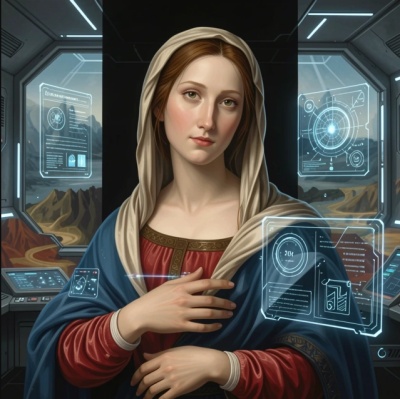
Image created with AI by https://raphael.app/it